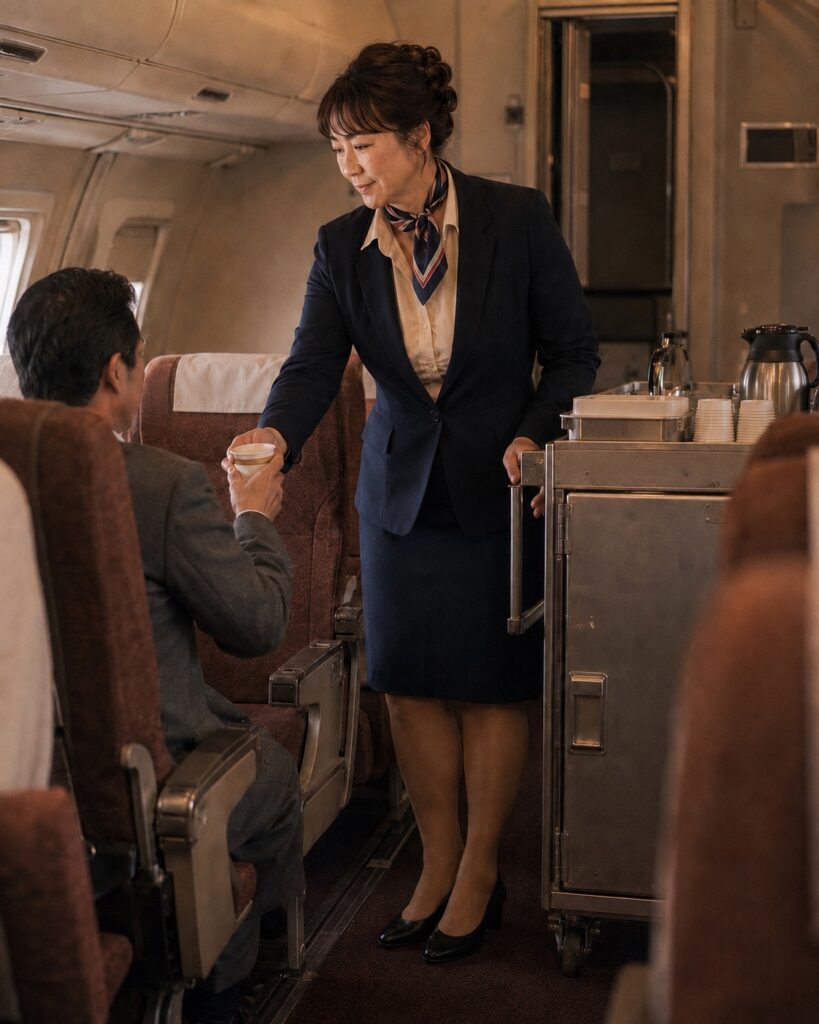
1979 / HANEDA AIRPORT / AVIATION / WORKING LIFE
Haneda Airport in 1979
To understand an airport in 1979, begin before the aircraft. The working world around Haneda included rail access, terminal circulation, staff rooms, crew briefing, passenger cabins, aircraft galleys and highly sequenced service routines.
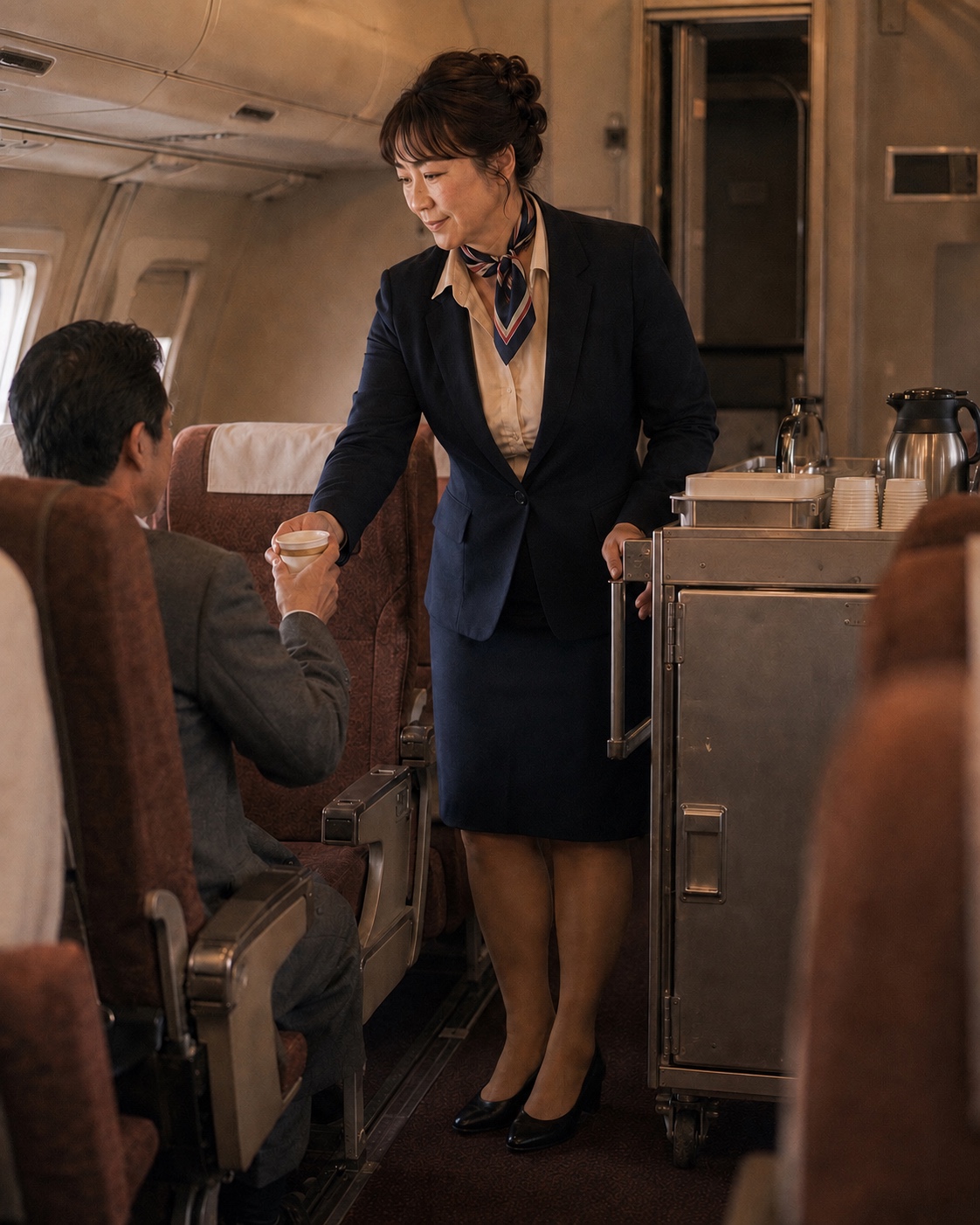
Haneda was a working system, not just a terminal.
Airport history is often told through aircraft types, airlines or major infrastructure. Everyday working history looks different. A flight attendant’s day connects transport, staff space, briefing, equipment, passenger movement and service into one continuous route.
OCS enters this system through Misaki Todo, a fictional adult flight attendant reconstructed inside a researched 1979 setting. Her exact shift is fictional; the goal is to make the period’s working environment legible.
The route begins on the Tokyo Monorail
The airport shift starts before arrival at Haneda. The Tokyo Monorail links the city to the airport and makes commuting part of the aviation system. Uniform, bag, timetable, station movement and terminal access all belong to the same working day.
This is why OCS does not isolate the aircraft as a complete world. Infrastructure outside the cabin determines how the worker reaches it.
Crew briefing before passenger service
A flight does not begin when passengers board. Staff preparation comes first: information exchange, role assignment, safety awareness and the transition from public terminal space into operational work.
The crew room is therefore a key historical space. It makes visible the organization behind what passengers experience later as smooth cabin service.
Cabin and galley as narrow workplaces
The passenger cabin is simultaneously a public environment and a tightly constrained workplace. Movement is shaped by seats, aisles, overhead space, safety equipment and service sequences. The galley reveals another layer: storage, preparation and the logistics behind a simple drink or meal.
For visual reconstruction, these spaces matter more than generic “retro airline” decoration. The relationship between worker, equipment and narrow architecture creates the period’s physical rhythm.
Five doors into Haneda in 1979
The commute is part of the airport working system.
Passenger and staff circulation intersect.
Preparation and briefing happen before boarding.
A public space that is also a narrow workplace.
Hidden logistics behind passenger service.
Follow the full working day.
Misaki Todo connects the monorail, terminal, briefing, cabin and galley into one reconstructed shift.
Misaki Todo — Flight Attendant at Haneda, 1979 → · 1970s Japan → · Japanese Women in the Showa Era →
FAQ
What does this page reconstruct?
It reconstructs the material route around a flight attendant’s working day: transport to Haneda, staff preparation, aircraft cabin, galley and service sequence.
Is Misaki Todo a real historical flight attendant?
No. Misaki is a fictional adult character used to connect researched workplace elements into one coherent visual route.
Why focus on ordinary airport work?
Routine work reveals the systems that spectacular aviation images often hide: commuting, staff space, preparation, equipment and repeated physical tasks.
About the reconstruction
The exact woman and shift are fictional. OCS uses period research to constrain transport, facilities, workspaces, equipment and routines, while keeping unsupported private detail inside the reconstruction layer. Read the OCS Historical Reconstruction Standard.