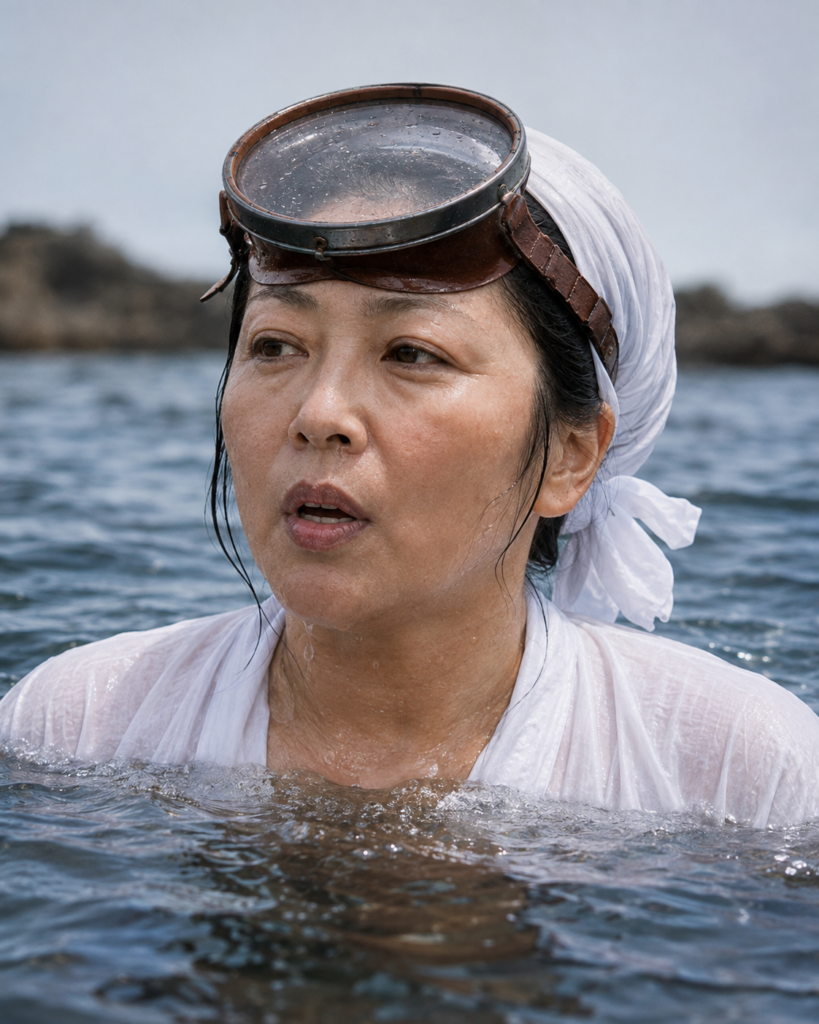
OCS ARCHIVE / SOUND / BODY TECHNIQUE / AMA
What is isobue?
Isobue is not a flute. It is the flute-like recovery breathing sound of ama divers after surfacing from a breath-hold dive.
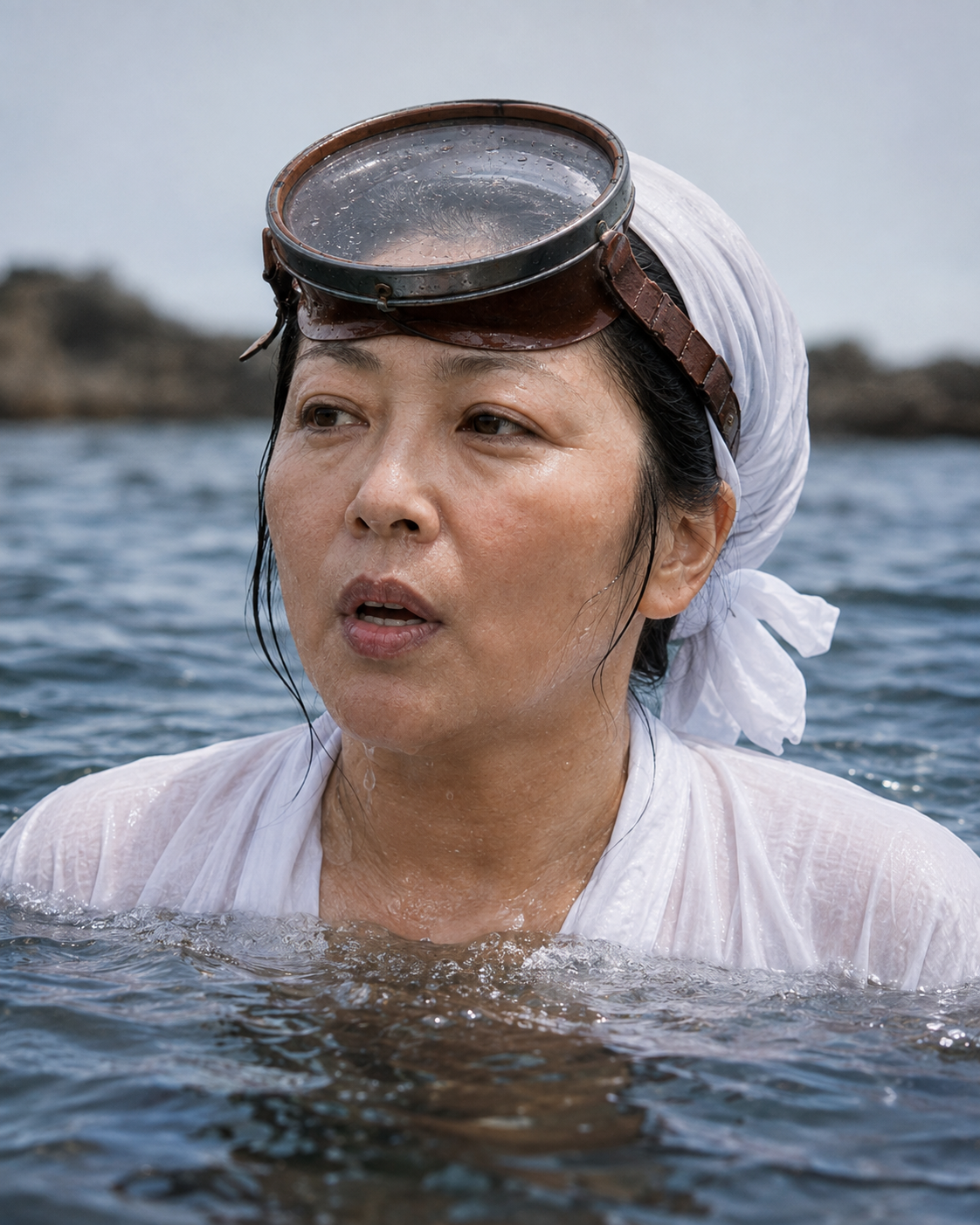
The sound of a working body.
Mie Prefecture’s cultural materials explain that ama divers exhale in a long, controlled way after surfacing and restore their breathing. The resulting whistle-like sound is called isobue. It comes from the diver’s breath, not from an object held in the hand.
The sound belongs to the rhythm of repeated work: descend on one breath, search and gather, return to the surface, exhale and recover, then prepare to dive again. Dive duration and depth vary by person, place and fishing method. OCS does not impose one fixed number on every reconstructed scene.
Dive → surface → exhale → recover.
- The ama enters the water on a breath-hold dive.
- She searches and gathers at the seabed.
- She returns to the surface.
- She exhales slowly and resets her breathing.
- The characteristic sound is heard as isobue.
1972 Anori: what is fact?
The existence of isobue within the ama culture of Toba and Shima is supported by official sources. OCS treats the breathing practice and sound as FACT. Shino Hamasaki, her exact expression and body position, the sea state and the camera viewpoint are RECONSTRUCTION / FICTION. The visual is not presented as a documentary image of one woman photographed in 1972.
C027 — the moment after surfacing.
In Shino EP01, isobue appears immediately after the dive. Unlike the iso-megane or kaginomi, it shows a moment when the body itself becomes the working instrument. The page connects sound, workflow and recovery rather than treating isobue as a stand-alone curiosity.
Related nodes.
Return to Shino EP01.
Follow the sequence from preparation in the hut to the boat, dive, isobue, return and warming.
Sources.
- Mie Prefecture — Ama fishing techniques
- Shima City — Japan Heritage: Toba and Shima
- NDL Search — Seiko Segawa, Ama (1970)
Provenance: RECONSTRUCTED / VISUAL FICTION.
A sound, not a prop.
Isobue is archived beside tools and facilities because sound can reveal the physical rhythm of work. It connects the underwater task to the body’s recovery at the surface and helps the episode remain centered on labor rather than spectacle.