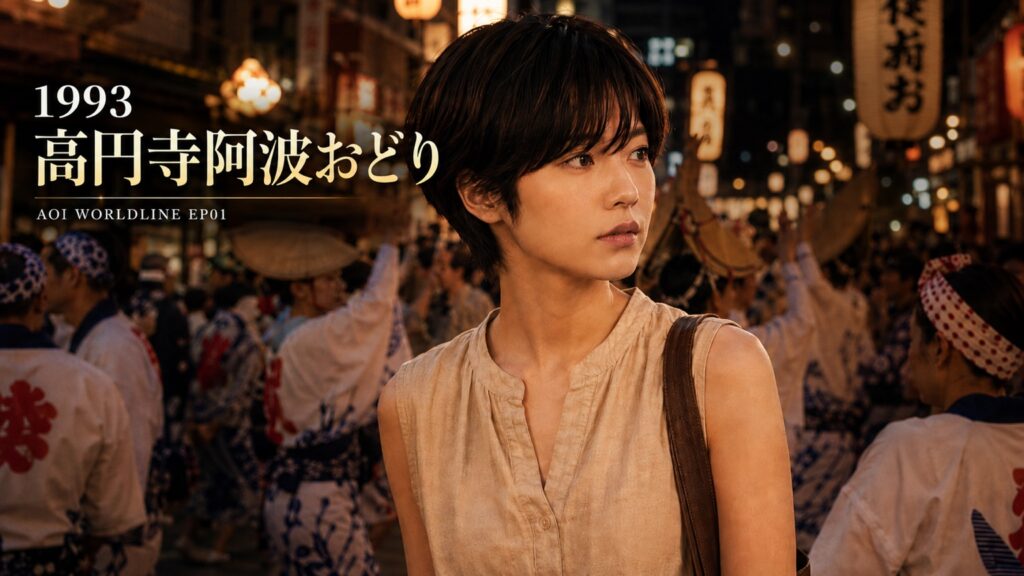
1993 / KOENJI / TOKYO / AWA ODORI
Koenji Awa Odori in 1993
Tokyo Koenji Awa Odori began in 1957 as a local effort to bring energy to the shopping streets around Koenji. By the 1990s it had become an established summer festival culture built from dance groups, street routes, spectators, music and the dense physical atmosphere of late-August Tokyo.
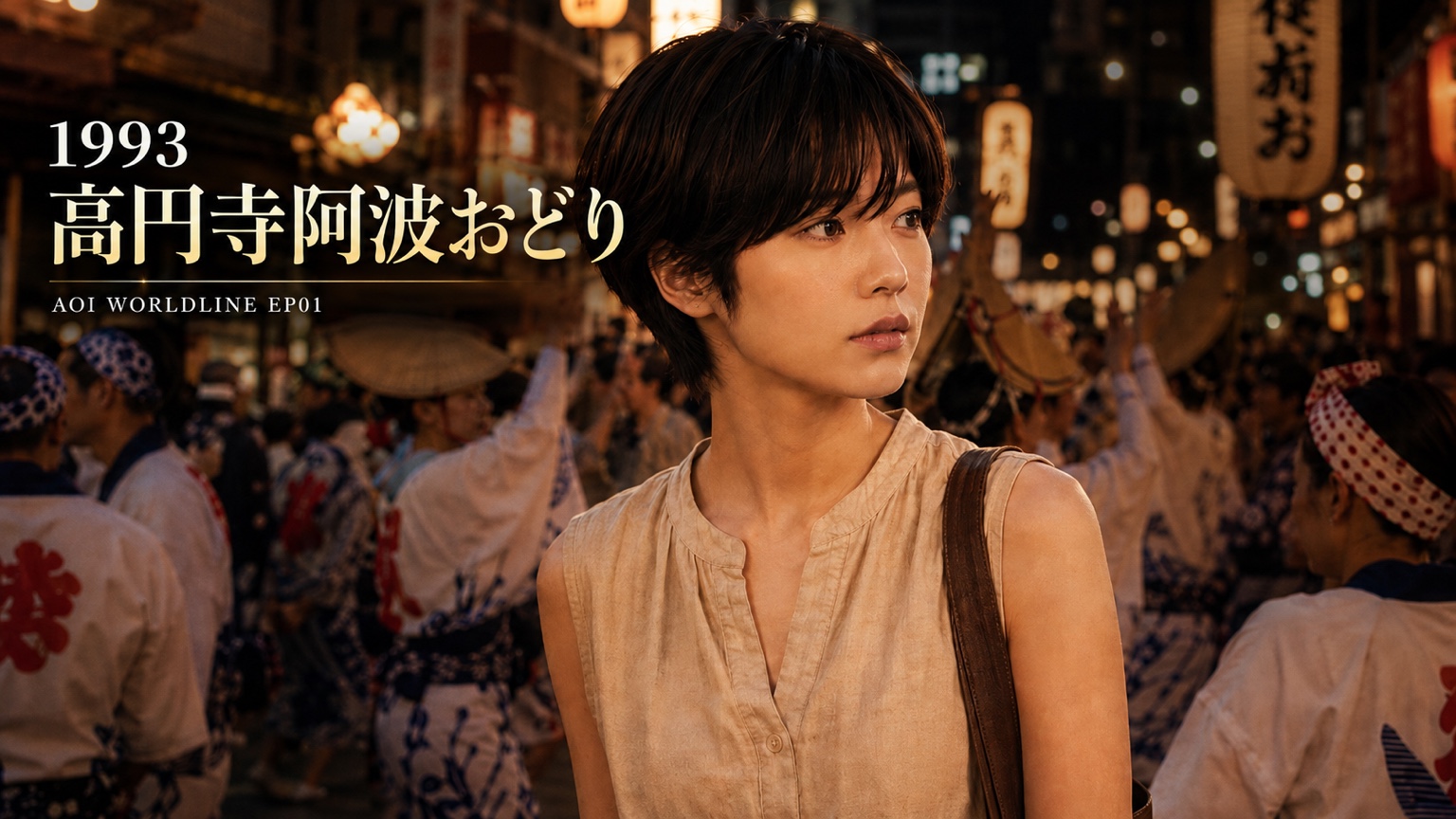
What is Koenji Awa Odori?
Awa Odori originated in Tokushima and developed into one of Japan’s best-known dance traditions. Koenji’s version is a Tokyo festival with its own postwar history. The official Tokyo Koenji Awa Odori association records the first event in 1957 and describes how the festival expanded from a local shopping-street event into a larger town-wide summer tradition.
The dancers perform in groups known as ren. Music and rhythm are supplied by narimono players using instruments associated with Awa Odori performance. The viewer does not experience the festival as a static stage show: dancers, musicians, spectators, lantern light, street fronts, heat and crowd movement all occupy the same urban space.
1993: a mature festival inside an ordinary neighborhood
OCS uses 1993 as a tightly constrained visual year rather than a generic “retro Tokyo” label. The reconstruction keeps the festival inside the material world of the early 1990s: clothing, street lighting, storefront scale, crowd behavior and photography are treated as period elements rather than modern props with a nostalgic filter.
The official Koenji festival history identifies the 1990s as a period when Awa Odori activity had become deeply established as local culture. OCS does not claim that one reconstructed storefront, spectator or exact camera angle documents the real 1993 event. Those details remain reconstruction.
Narimono: the festival is heard as well as seen
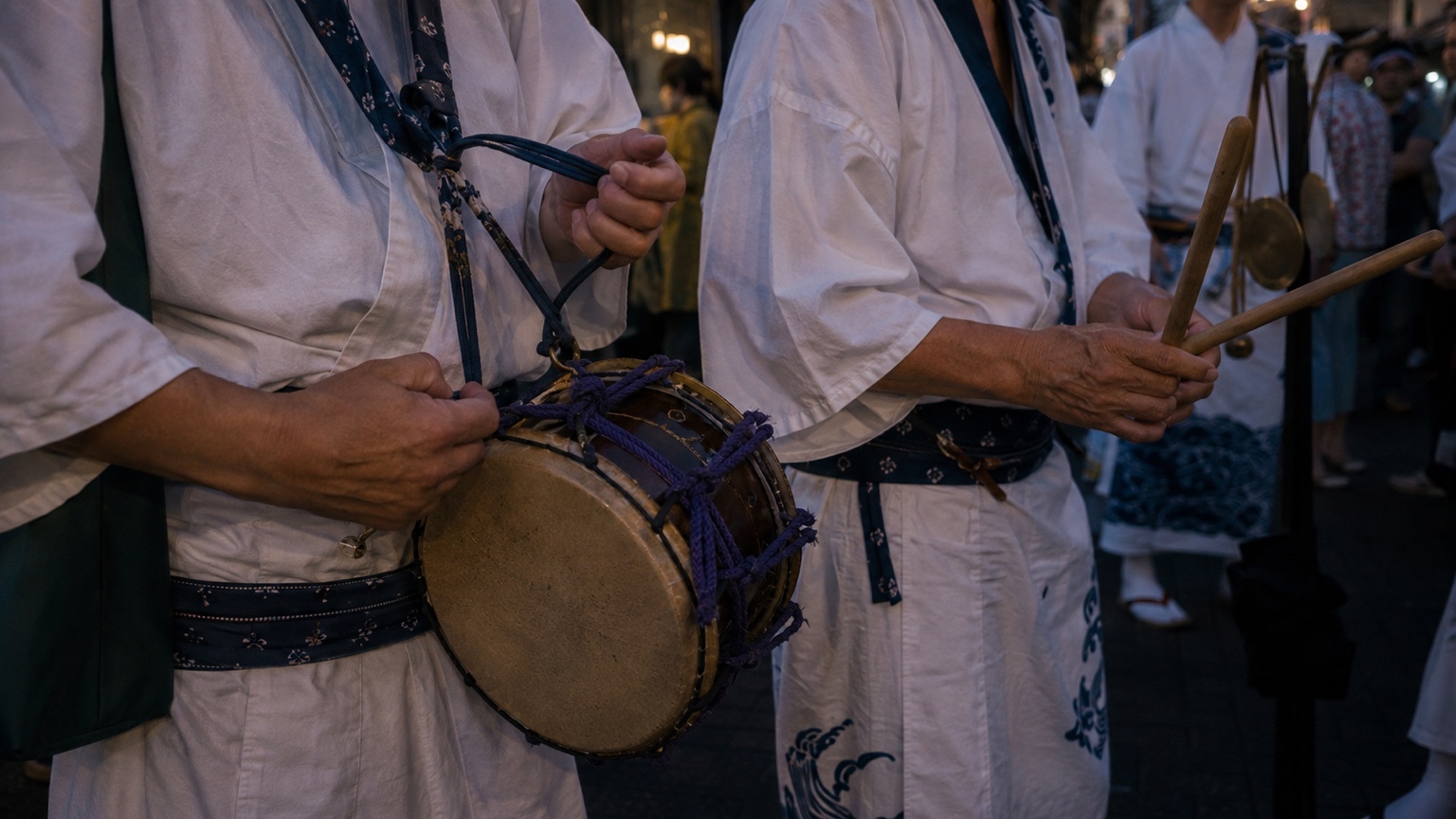
One reason Koenji works as an OCS WORLD subject is that the festival cannot be explained by a portrait alone. The music has a physical source: people prepare instruments, carry them, keep rhythm and move with the dance. That makes narimono an object-and-action layer connecting CULTURE, OBJECT, SOUND and LIFE.
Summer heat, fans and the spectator’s body
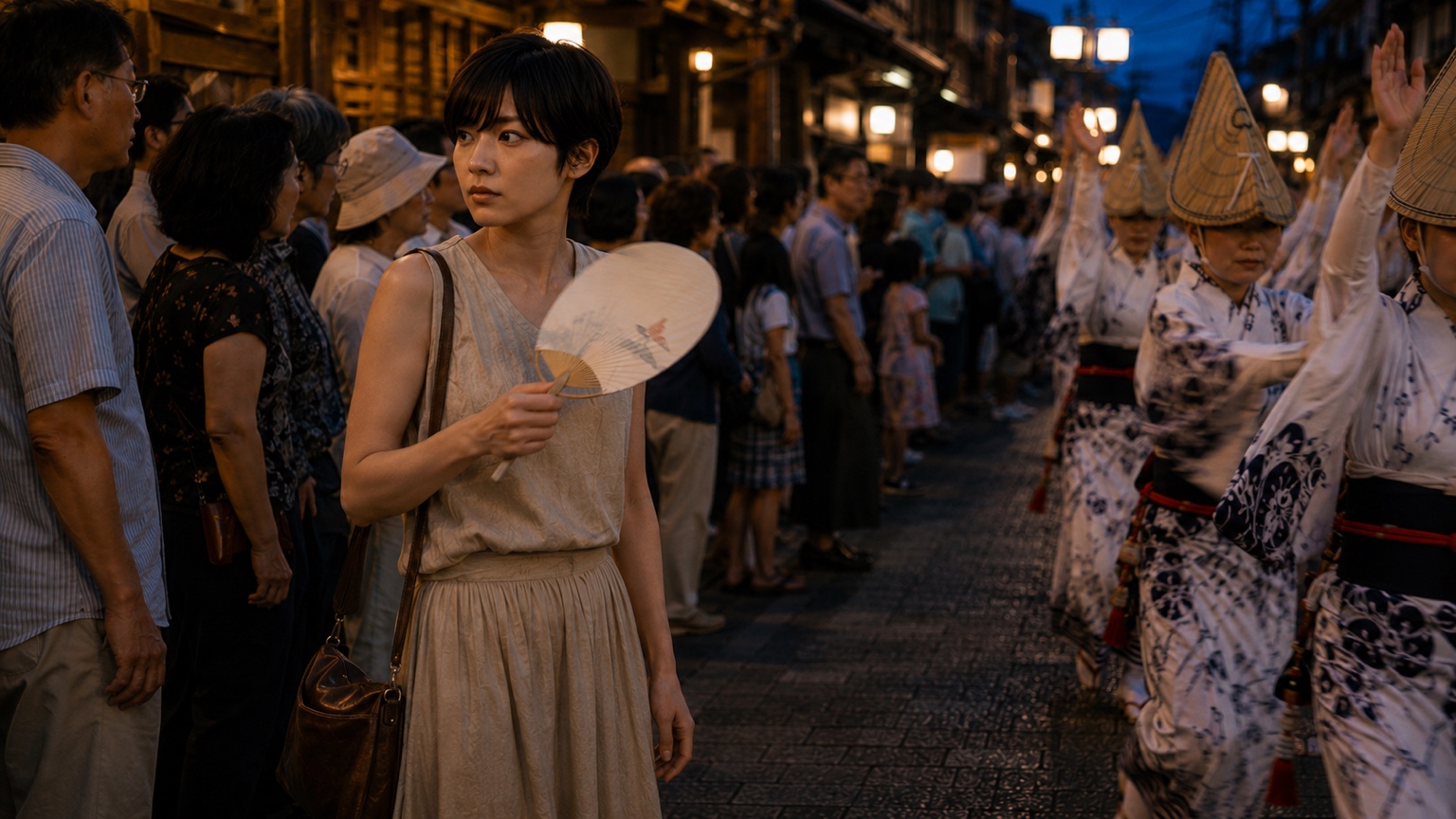
An ordinary object such as an uchiwa matters because a summer festival is also a climate system. Heat, humidity, waiting, crowd density and the repeated use of a hand fan make the historical world physically legible without explanation.
Aoi Ichinose: the human doorway
OCS WORLDLINE — AOI 1993 enters Koenji through Aoi Ichinose, a fictional young woman moving through the festival at night. Aoi is not a documented historical person. She is the viewpoint through which the street, dancers, narimono, spectators and summer night become one continuous world.
Fact and reconstruction
FACT: Tokyo Koenji Awa Odori began in 1957 and developed from a local shopping-street festival into a major Koenji summer tradition. Awa Odori is performed by groups called ren, accompanied by music and rhythm.
RECONSTRUCTION / FICTION: Aoi Ichinose, her exact route, expressions and private experience are fictional. Individual storefront details, crowd positions and camera viewpoints are not presented as documentary records of one exact night in 1993.
Sources
- Tokyo Koenji Awa Odori Association — English overview
- Tokyo Koenji Awa Odori Association — historical chronology
- Tokyo Koenji Awa Odori Association — commemorative historical publications
OCS images are research-based visual reconstructions, not genuine photographs taken in Koenji in 1993. Read the OCS Historical Reconstruction Standard.