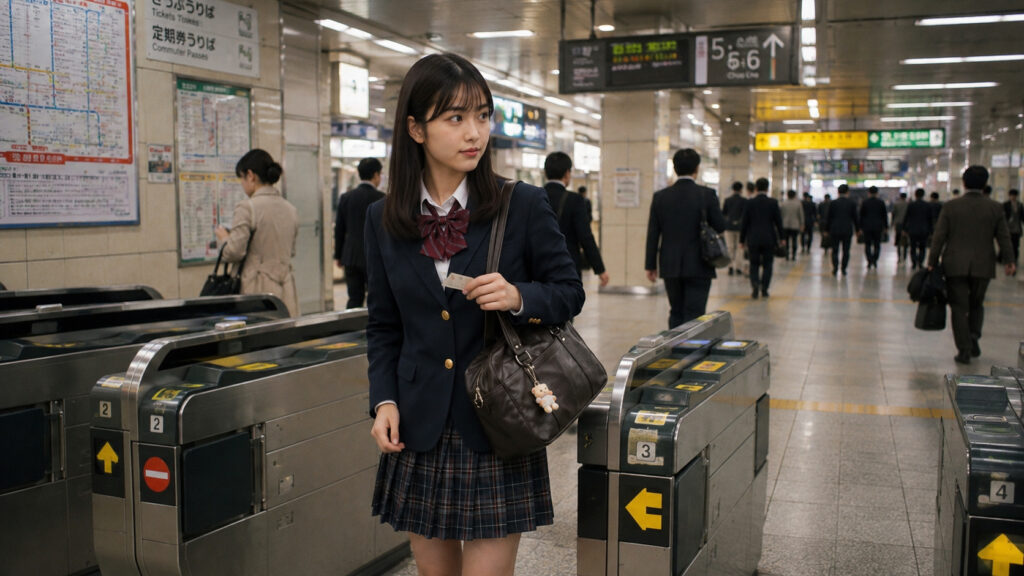
1996 / JAPAN / TOKYO / EVERYDAY TECHNOLOGY
1996 Japan
Japan in 1996 was already highly modern, but everyday life still depended on physical interfaces that smartphones would later absorb: paper train tickets, pagers, CD shops, photo-sticker booths and dedicated karaoke systems.
What did everyday life in Japan look like in 1996?
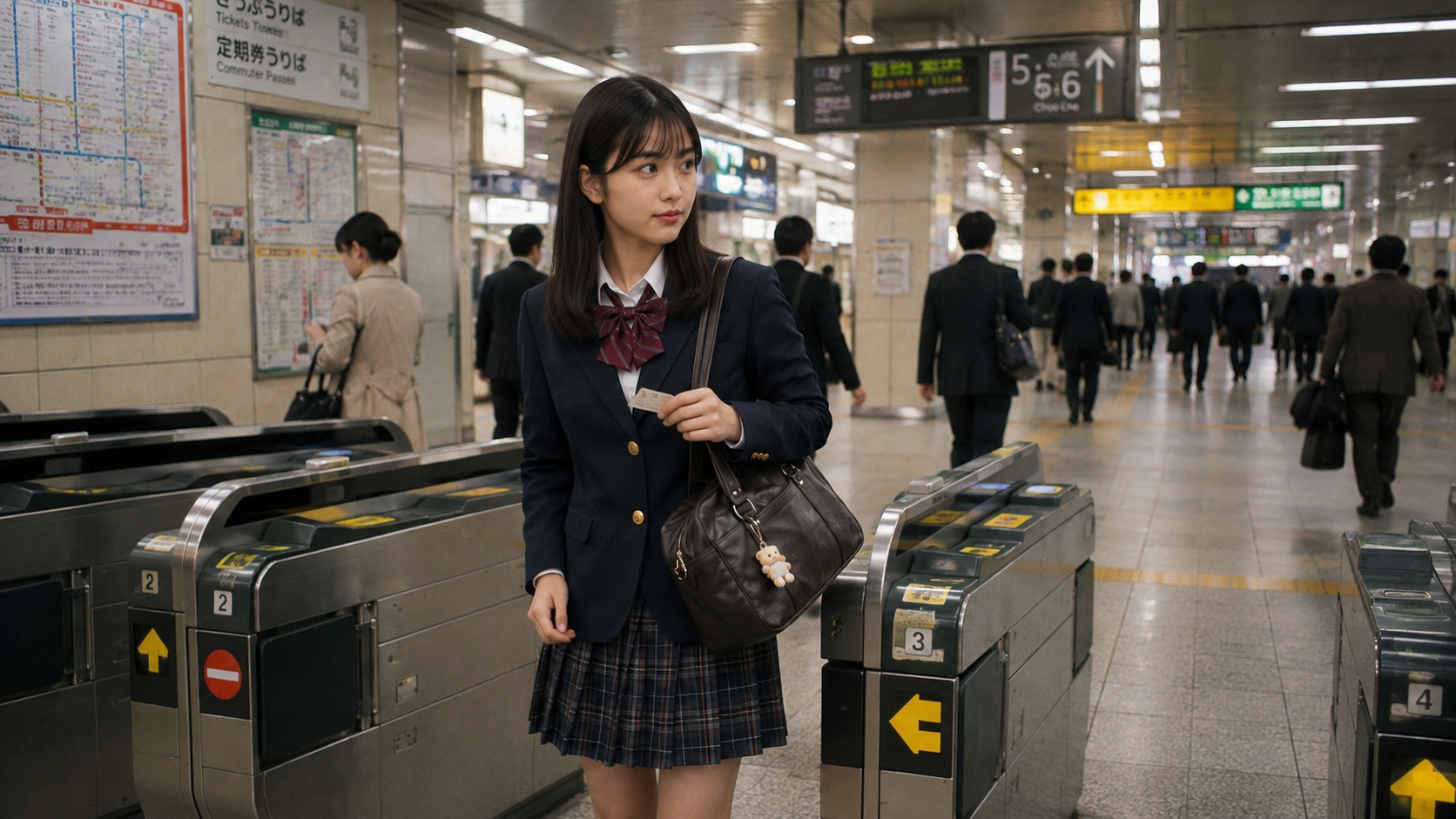
The answer depends on age, place and routine. OCS enters the year through Mio Kamiya, a fictional 17-year-old student moving through home, station, school and Shibuya. The point is not to claim her day represents all of Japan. It is to use one constrained route to make the year tangible.
In that route, communication, transport, music, photography and entertainment are separate physical systems. Each one asks the body to do something specific: buy a ticket, check a pager, browse a shelf, enter a booth, hold a microphone.
Paper train tickets and station gates
Rail travel begins with a small object. A magnetic paper ticket is bought, carried, inserted into an automatic gate and used again at the destination. The system is fast and modern, but still visibly physical.
This matters historically because the interface shapes movement. A ticket has to be held, stored and presented. The commuter carries part of the transport system in her hand.
Pagers: portable messages without a smartphone
A pager can alert or display information while leaving many other actions unresolved. Receiving a message and responding to it may happen in different places and through different devices.
That separation is one of the clearest differences between 1996 and later smartphone life. Communication is portable, but not yet consolidated into one screen.
CD shops, purikura and karaoke
Music discovery is spatial: shelves, cases and listening stations. Early purikura turns a social photograph into a printed sticker that can be carried and exchanged. Karaoke is organized around a dedicated room, screen, song system and wired microphone.
These are not just nostalgic props. They are interfaces that structure social behavior.
Five doors into 1996 Japan
A physical object connecting rider and station system.
Portable communication before the all-purpose phone.
Music browsing as a physical retail experience.
A photograph becomes a small printed social object.
A dedicated room and machine define the experience.
Follow one complete day in Tokyo.
Mio Kamiya connects the objects back into a continuous route from home to station, school, Shibuya and back again. For a district-level entry point, continue to Shibuya in 1996.
Mio Kamiya — A Day in Tokyo, 1996 → · 1990s Japan → · Visual Archive →
FAQ
Was Japan already technologically advanced in 1996?
Yes, but many everyday technologies were dedicated physical systems rather than functions consolidated into smartphones. Modernity did not mean digital convergence.
Were pagers used in Japan in the 1990s?
Pagers were part of the period’s communication landscape, especially before mobile phones became dominant. OCS uses them as one material interface in the 1996 Tokyo reconstruction.
What makes 1996 visually different from today?
The biggest difference is often not architecture but interaction: tickets, pagers, CDs, printed photos and purpose-built machines all make daily actions more visibly physical.
About the reconstruction
Mio Kamiya is fictional. The year, period objects and systems are researched; the exact student, school, shops, conversations and private day are reconstructed or fictional. Read the OCS Historical Reconstruction Standard.