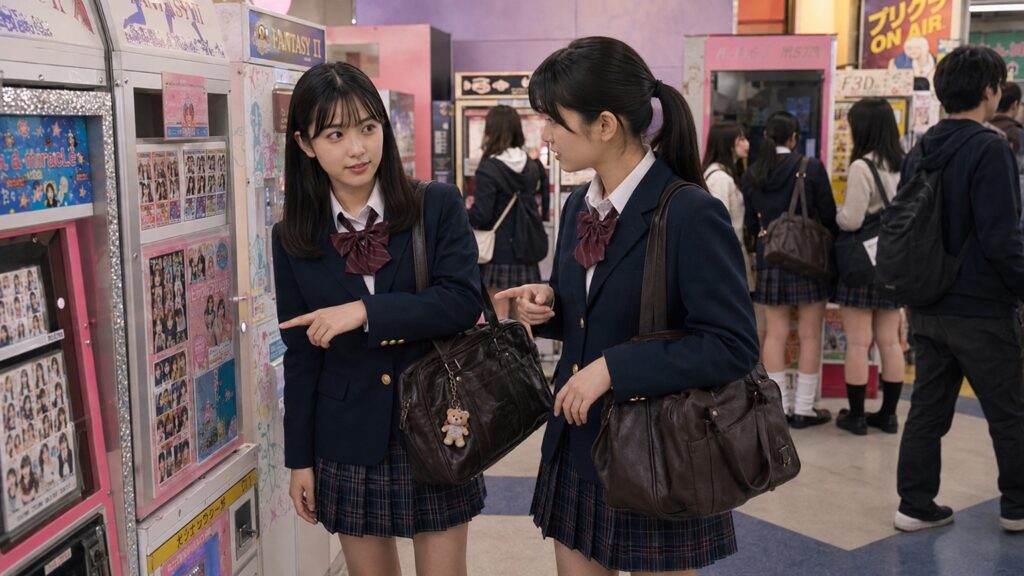
1996 / JAPAN / PURIKURA / YOUTH CULTURE
Purikura in Japan in 1996
Purikura was still new in 1996. Sega and Atlus released the original Print Club machine in July 1995, and the format quickly became a new social object: take a photograph together, receive a small sheet of printed stickers, then carry, exchange and collect the images.
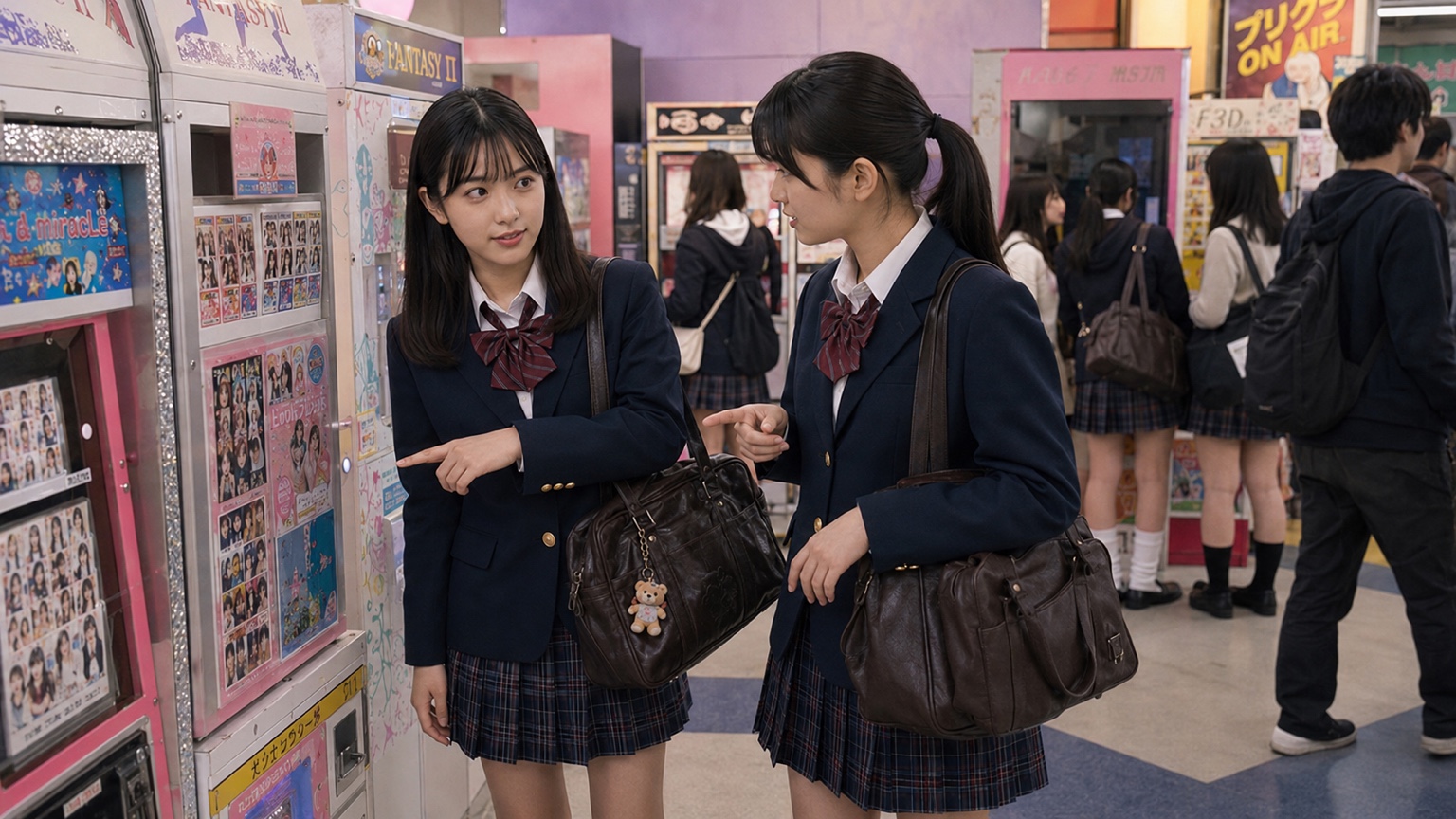
What was early purikura?
The first machine was called Print Club, produced by Sega and Atlus. Sega’s corporate history records its arrival in July 1995. The photograph did not remain on a screen. It emerged as a sheet of small printed stickers, making the image a portable physical object that could be cut, shared, stuck into notebooks and exchanged with friends.
This physical circulation is the reason purikura matters to OCS. It is not simply “an old photo booth.” The booth, camera, print sheet and sticker book form a small social system connecting TECHNOLOGY, OBJECT and CULTURE.
Why 1996 is historically useful
Because the first Print Club appeared in 1995, a 1996 reconstruction places purikura close to the beginning of the phenomenon rather than treating every 1990s machine as identical. Later print-sticker machines developed different interfaces, image effects and editing functions. OCS therefore keeps the exact cabinet graphics and interface generic unless a model-specific source is locked.
The claim is deliberately narrow: purikura existed by 1996 and was entering youth culture. OCS does not claim that the fictional booth shown here reproduces one documented machine in one specific Shibuya store.
A photograph that becomes an object
Today, a casual social photograph can be captured, edited and distributed on one phone. Purikura made a different sequence visible. Friends entered a dedicated machine, posed, waited for the print, then handled a sheet of stickers. The result occupied physical space: a school notebook, wallet, diary, letter or collection.
That change in interface makes 1996 easier to understand. The social photograph is not yet an endless digital stream. It is a small manufactured object with edges, quantity and a place to be stored.
Mio Kamiya and Shibuya, 1996
OCS enters this material culture through Mio Kamiya, a fictional high-school student moving through Tokyo in 1996. Her route connects paper train tickets, a pager, Shibuya, purikura and karaoke into one ordinary day. The character is fictional; the period technologies are researched separately.
Mio Kamiya — Tokyo, 1996 → · Shibuya in 1996 → · 1996 Japan →
Fact and reconstruction
FACT: Sega records the appearance of Sega/Atlus Print Club in July 1995. Sega’s 30th-anniversary history of print-sticker machines identifies the first machine as released on July 25, 1995 and describes the subsequent rapid growth of the format.
RECONSTRUCTION: Mio, her friends, the exact booth exterior, screen interface, decals, store and exact Shibuya location are not claimed as documentary facts.
Sources
OCS visualizations are reconstructions. Read the OCS Historical Reconstruction Standard.
Related 1990s Japan nodes
Pagers in Japan in the 1990s · 1990s Japan · English Visual Archive