SHOWA JAPAN / WOMEN / WORK / EVERYDAY LIFE
Japanese Women in the Showa Era
The Showa era lasted from 1926 to 1989, but there was no single way to be a woman in Showa Japan. Work, age, region, class, family structure and technology shaped daily life very differently. OCS approaches that long period through specific researched lives rather than one generic nostalgic image.
Showa women cannot be reduced to one stereotype.
Popular images of Showa Japan often compress decades into a small set of visual symbols: uniforms, department stores, neon streets, domestic interiors or postwar consumer goods. Those images can be useful, but they become misleading when they erase differences between coastal labor, urban service work, office life, travel, family routines and regional culture.
OCS therefore begins with a person in a precise year and place. The woman is the doorway; the wider target is the system around her—work, clothing, transport, tools, architecture and everyday objects.
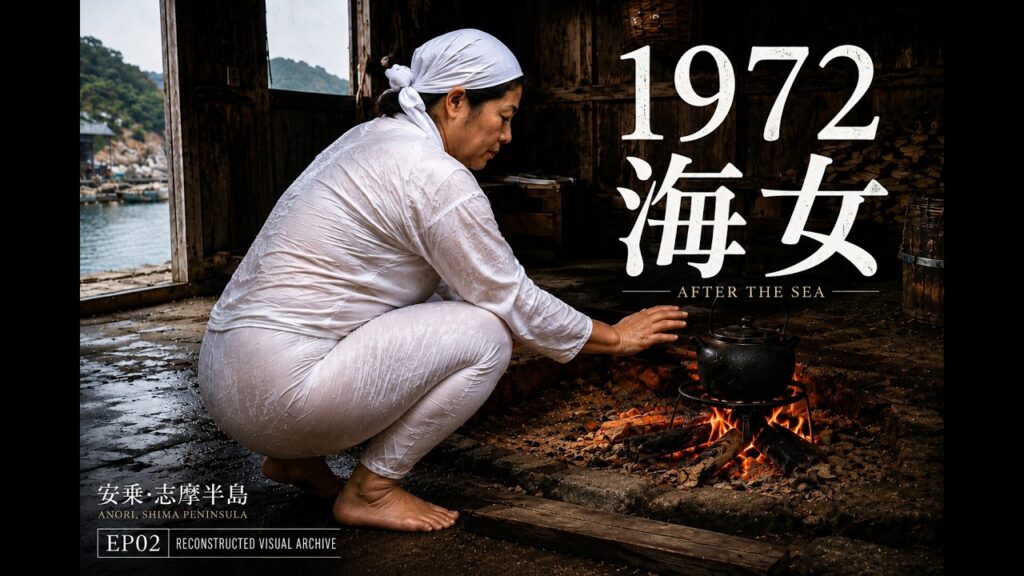
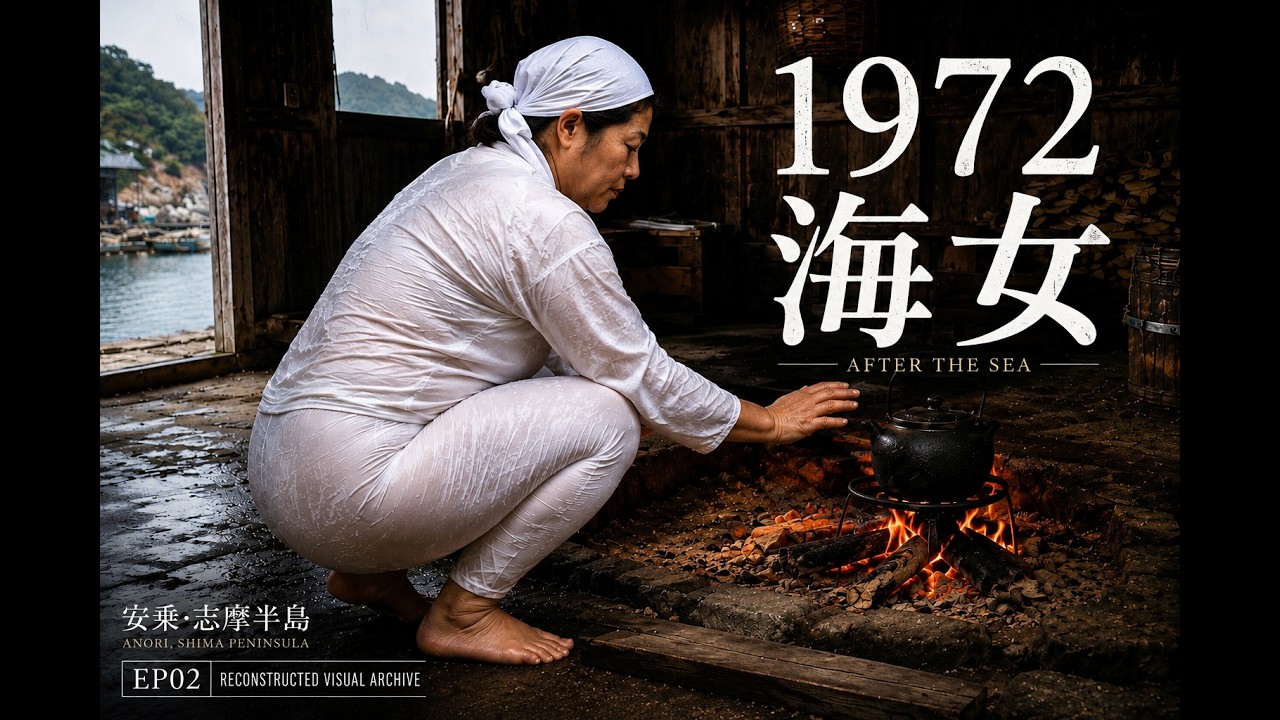
1972: an ama diver in Anori, Mie
Shino Hamasaki is a fictional adult woman used to enter a researched working world in 1972 Anori. Her day is organized around the sea: white work clothing, iso-megane diving goggles, a kaginomi hand tool, repeated breath-hold dives, surface recovery and warmth inside the ama hut.
The importance of this archive is not that one fictional woman stands for all Japanese women. It is that one constrained working life reveals the relationship between body, labor, equipment, place and regional tradition.
1979: a flight attendant working through Haneda
Misaki Todo opens a very different Showa working system. Her route runs through the Tokyo Monorail, Haneda Airport, staff spaces, briefing, passenger cabin, aircraft galley and service work.
Here the visual history is built from institutional movement: uniforms, transport infrastructure, narrow workspaces, equipment and routines. The result is a different Japan from 1972 Anori even though both belong to the same decade.
What changed for women across late Showa?
There is no single answer, but the material world changed visibly. Transport systems expanded, service work became more standardized, consumer goods multiplied, workplaces became increasingly mediated by machines and paper systems, and urban life grew denser. At the same time, older forms of regional labor and household practice continued alongside newer institutions.
That overlap is one reason late Showa is visually rich. Traditional and modern systems often coexist in the same decade, sometimes in the same life.
How OCS reconstructs women’s everyday history
Tasks, sequences, tools and physical movement.
Dress as workwear, institutional identity and weather protection.
Coast, airport, home, street or workplace as active systems.
Tools, tickets, records, furniture and dedicated machines.
Continue through late Showa Japan.
Compare 1972 coastal work with 1979 aviation, then move forward toward the physical interfaces of 1990s Japan.
FAQ
When was the Showa era in Japan?
The Showa era ran from 1926 to 1989. Because it covered more than six decades, women’s work and everyday life changed enormously across the period.
What kinds of work did Japanese women do in the Showa era?
There was no single pattern. Women worked across agriculture, fishing, manufacturing, offices, retail, hospitality, transport and many other fields, while unpaid household labor also remained central to many lives.
Why does OCS focus on individual women?
A single constrained life makes large historical changes easier to see. Clothing, tools, transport and workplaces become connected through ordinary action rather than presented as isolated retro objects.
Related English archive pages
Ama Divers in Japan · Haneda Airport in 1979 · 1970s Japan · 1996 Japan
About the reconstructions
OCS characters are fictional unless explicitly identified as historical people. Period setting, tools, facilities and work systems are researched; exact faces, private moments and camera positions are reconstruction or fiction. Read the OCS Historical Reconstruction Standard.