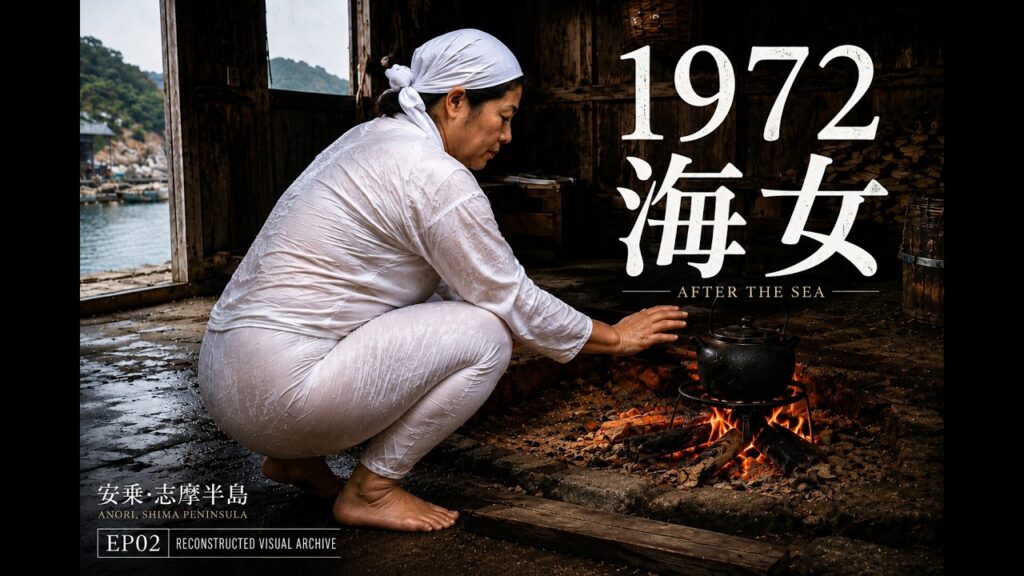
OCS VISUAL ARCHIVE / YEAR NODE
1972 JAPAN
What was everyday life in Japan like in 1972? There was no single answer. OCS uses one detailed local case—ama work in Anori, Mie—to make the year legible through work, clothing, tools, facilities, movement and recovery rather than through nostalgia alone.
What this year node contains.
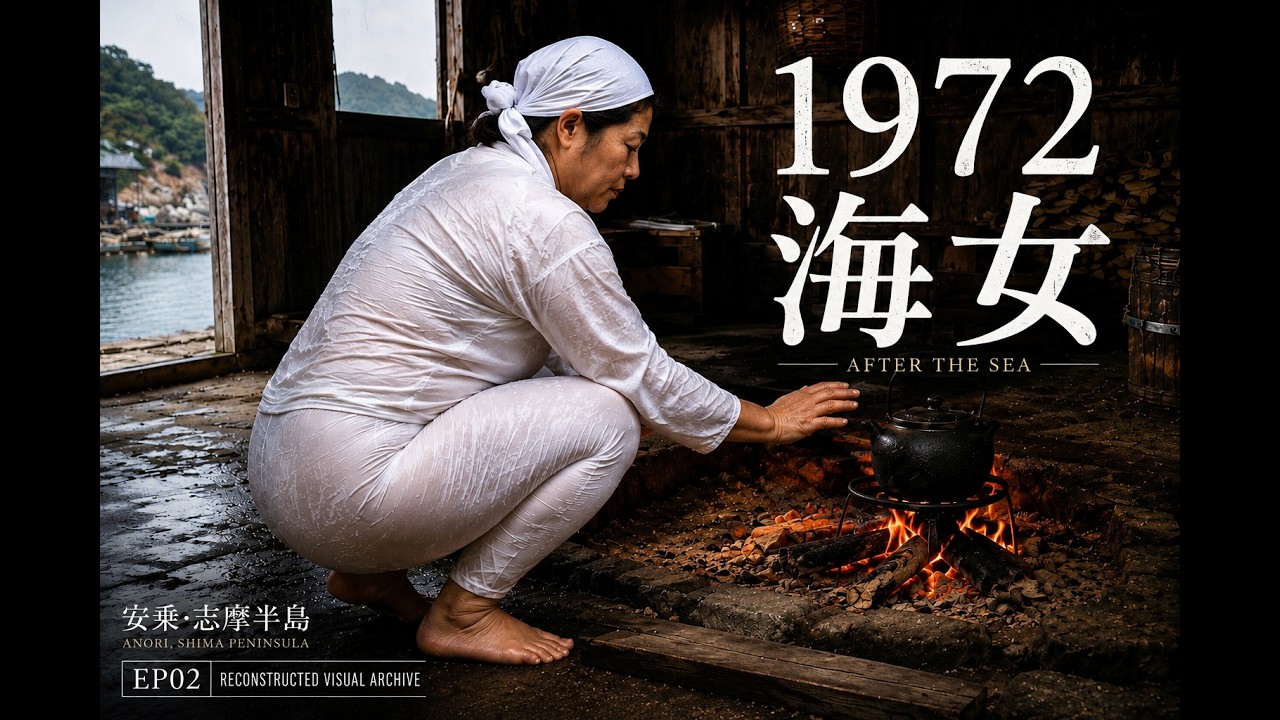
OCS’s first complete record placed in 1972 follows Shino Hamasaki, a fictional forty-year-old ama diver in Anori on the Shima Peninsula. The archive records the white isogi workwear, iso-megane diving goggles, kaginomi, floats, catch bags, the ama hut, communal boat and the breathing sound known as isobue as connected parts of one working world.
This page does not claim that Shino existed, or that the images document one actual day in 1972. The year and place set the scope of the research. Official materials on ama culture in Toba and Shima and near-period sources are used to examine the work, facilities and equipment. Faces, private actions, expressions, exact room arrangements and camera viewpoints remain reconstruction or fiction.
Key archive nodes.
PLACE: Anori, Mie
WORK: 1972 Anori Ama Hub
OBJECTS: Iso-megane, kaginomi, isobue
FACILITY: Ama hut
PERSON: Shino Hamasaki
EPISODES: EP01 and EP02
From a year to a working sequence.
EP01 moves from preparation in the ama hut to the harbor, communal boat, dive, gathering work, ascent, isobue and return. EP02 stays with the body after the sea: wet clothing, hands, warmth, the hut and the gradual return to ordinary time. Together they make the year legible through actions rather than nostalgia alone.
Continue with Shino.
Enter EP01, watch the films, or read the longer visual sequence through OCS publications.
What this 1972 case can—and cannot—tell us.
Anori is not a stand-in for all of Japan. Its value is the opposite: it keeps the archive specific enough to test material details. A coastal working life can reveal relationships between body, weather, tools, local facilities and occupational rhythm without claiming that the same experience applied to an office worker, a city household or another region in 1972.
For the equipment layer, continue to Japanese Ama Diving Equipment. For the wider decade, compare this local case with 1970s Japan.
FAQ
What was Japan like in 1972?
Everyday experience differed by place, work, age and household. This page uses Anori ama work as one detailed case rather than claiming a single national lifestyle.
Why focus on ama diving?
The OCS Anori line has connected evidence for work sequence, equipment, facilities, place and recovery, making it a strong material-history doorway into the year.
Is Shino Hamasaki a real woman from 1972?
No. She is a fictional adult character inside a researched year, location and working system.
Research frame.
The 1972 Anori line draws on official cultural materials from Mie Prefecture and Shima, together with near-period bibliographic evidence such as Seiko Segawa’s 1970 study of ama culture. These sources support regional practices and equipment; they do not prove every private action shown in the episode. The archive therefore preserves the year as a research boundary and keeps unsupported visual detail in the reconstruction layer.