KAN’EI ERA / 1640 / EVIDENCE / RECONSTRUCTION
The Ooku in Early Edo Japan: What Can Be Reconstructed for 1640?
A visually convincing Ooku can still be historically wrong. The main danger is chronology: famous floor plans, rank systems, customs and images often come from decades or centuries after 1640.
1640 belongs to the Kan’ei era
The target year sits before the Great Fire of Meireki in 1657 and before the Manji reconstruction completed afterward. That chronological position matters. A post-fire floor plan can help identify institutional vocabulary, but it cannot automatically establish the exact location of every room in 1640.
Two plans that must not be confused
The Tokyo Metropolitan Library preserves a plan catalogued as a Kan’ei-period overall Ooku plan. It also preserves another famous drawing labeled “Kan’ei-period Ooku” whose own catalogue notes explain that research identifies its contents as Manji-period. The labels therefore cannot be read mechanically.
This is exactly why OCS records DATE AUTHORITY separately from visual usefulness.
What later evidence can still contribute
Later plans can support recurring architectural concepts: controlled separation between Nakaoku and Ooku, differentiated residential and service areas, Nagatsubone quarters, Hiroshiki administration and formal residential spaces. Later records can also reveal categories of objects and work.
But the farther the source is from 1640, the lower its authority for exact dimensions, room names, ranks, etiquette and daily routine.
OCS reconstruction rule
Period-supported date, institution, broad spatial relation or documented object.
A relationship supported by several sources but not directly fixed for one room or day.
The specific room scale, surface, object placement or action needed to make the world visible.
The invented individual, private moment and exact episode route.
Specificity should fall when evidence weakens
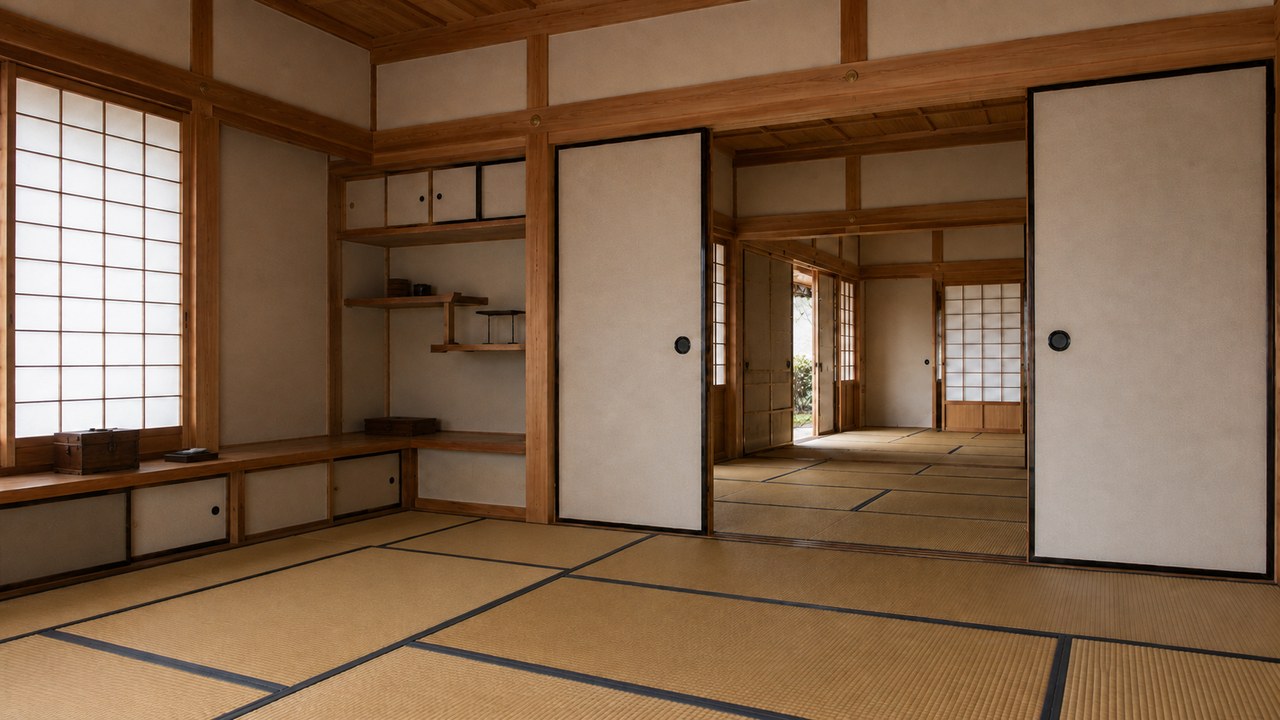
A historically responsible reconstruction does not fill every unknown with decorative certainty. When the source cannot support an exact screen pattern, shelf arrangement, rank title or room dimension, OCS keeps the detail generic and period-compatible.
Primary research doors
- Tokyo Archive — Kan’ei-period overall Ooku plan
- Tokyo Archive — plan labeled Kan’ei but catalogued as Manji-period content
- Tokyo Archive — Manji Honmaru Omote/Nakaoku/Ooku overall plan
This page is the date-control gate for OCS 1640 Ooku visual reconstruction. Research Standard →