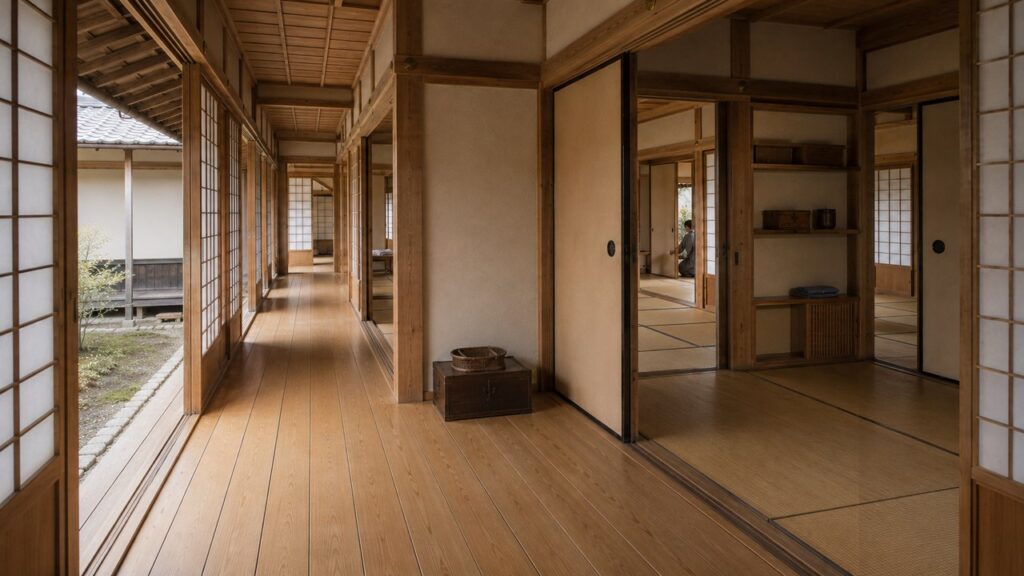
1640 / EDO CASTLE / HONMARU / LIVED WORLD
Edo Castle in 1640
Edo Castle was not only a fortress or symbol of Tokugawa power. Its Honmaru palace was a working environment in which government, residence, service, storage, circulation and household life occupied connected but differently controlled spaces.
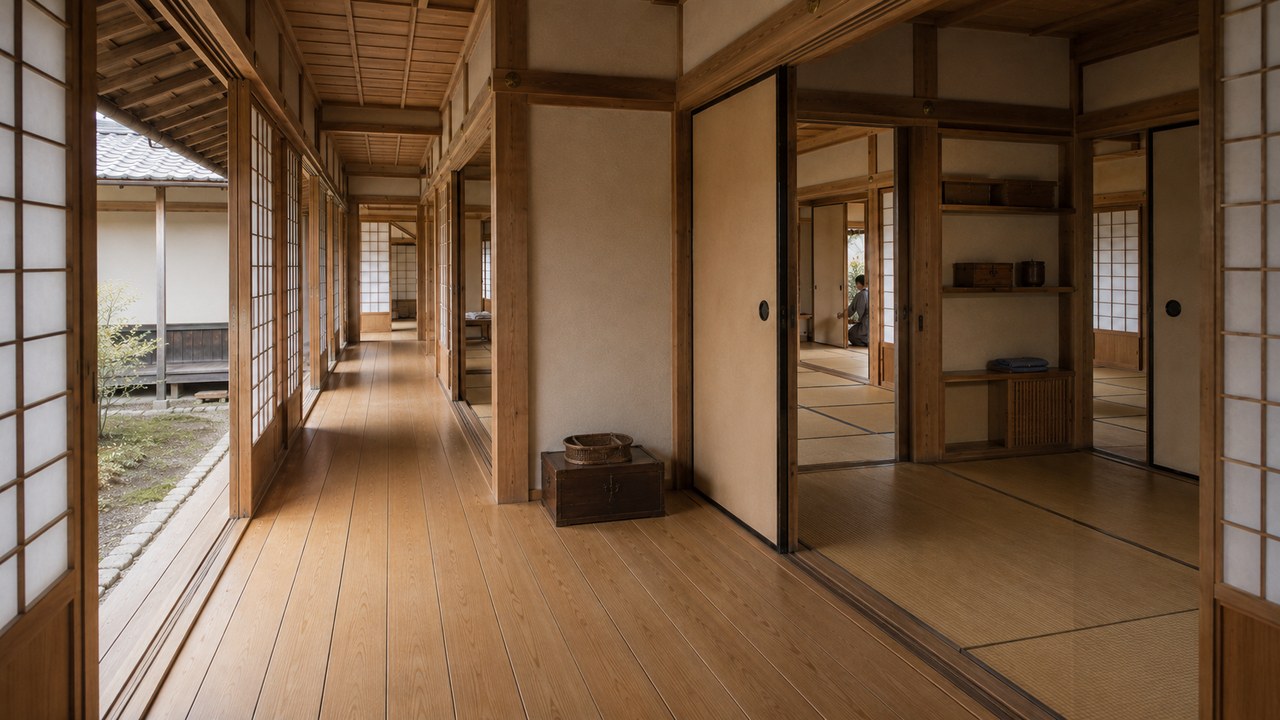
The Honmaru as a system
Historical plans and museum explanations distinguish a public-facing Omote, the shogun’s more private Nakaoku, and the women’s inner quarters commonly called the Ooku. Those labels help explain how access changed as a person moved deeper into the palace.
For OCS, this matters because architecture controls behavior. A corridor is not just a visual backdrop. It determines who may pass, what can be carried, where instructions travel and how work moves between rooms.
What can 1640 safely mean?
The year 1640 falls in the Kan’ei era, before the great Meireki fire of 1657 and the subsequent Manji rebuilding. Later floor plans are valuable evidence for institutional vocabulary and spatial relationships, but they cannot automatically be treated as exact maps of the palace in 1640.
OCS therefore separates period-supported structure from later architectural evidence. Where the exact Kan’ei room arrangement is not securely fixed, the reconstruction lowers specificity rather than presenting a later plan as contemporary fact.
Government and household life existed at the same time
Political history often pulls the eye toward audiences, shoguns and major decisions. A palace could not operate through ceremony alone. Rooms had to be prepared, clothing and objects had to move, messages had to arrive, servants had to coordinate routes, and people had to eat, rest, wait and repeat tasks.
This is the WORLD layer OCS reconstructs: the relationship between SPACE, OBJECT, FACILITY, PHYSICS, CULTURE, EVIDENCE and LIFE.
Enter the inner quarters
The Ooku makes the Honmaru legible at human scale: rooms, female attendants, service routes, storage and repeated household work.
Ooku in Edo Castle → · Women Working in the Ooku → · Reconstructing the Ooku in 1640 →
What we looked at
This reconstruction was not copied from a single surviving plan. OCS combined early castle maps with architectural records and later, more detailed palace plans, using each source for a different purpose.
- Tokyo Metropolitan Library — Edo Castle construction records inherited by the Kora master-builder family: used for construction chronology and architectural context.
- Matsue History Museum — Edo Hajimezu, in Gokuhi Shokoku Shirozu: an early seventeenth-century castle plan used for enclosure relationships and orientation, not as a room-by-room 1640 palace plan.
- Tokyo Metropolitan Library — Keicho Edo Ezu: used to cross-check the relationship between Edo Castle, the inner enclosures and the surrounding city.
- Tokyo Metropolitan Library Archive — later Honmaru / Ooku plan: used comparatively for functional vocabulary and spatial relationships, not as exact 1640 geometry.
- National Archives of Japan — Edo Goten no Zu: used to study later palace-room functions, dimensions and service infrastructure.
- National Diet Library — Edo Castle Honmaru Omote and Nakaoku architectural drawings: a later comparative source for palace organization and architectural vocabulary.
FACT / INFERENCE / RECONSTRUCTION / FICTION
FACT covers securely supported dates, structures, documented terms and broad spatial relationships. INFERENCE connects evidence across sources of different dates. RECONSTRUCTION supplies the exact corridor sequence, lighting, object placement and movement needed to make a film. FICTION includes Otsune, the young samurai and other individual characters.
Special care is required with the word Ooku. A private inner household existed early, but OCS does not project the fully developed later Ooku — including later organizational and architectural forms — unchanged back into 1640.
OCS does not claim that a surviving later plan reproduces every room of Edo Castle exactly as it stood in 1640. Research Standard →