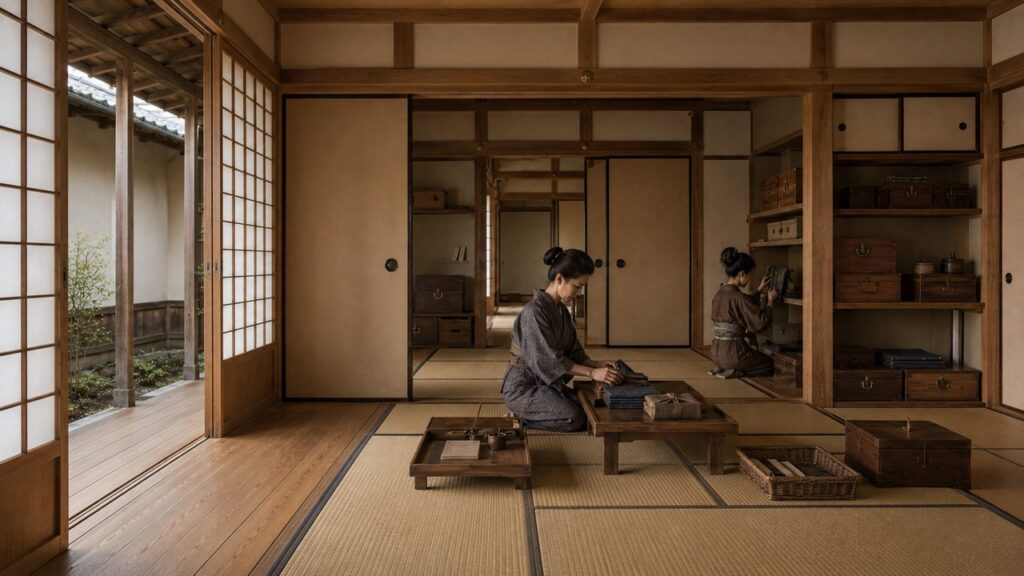
EDO CASTLE / OOKU / WOMEN / WORK
Women Working in the Ooku
The Ooku was a residential world, but it was also a workplace. Female attendants maintained rooms, clothing, objects, messages, schedules, protocol and the ordinary continuity of life inside Edo Castle’s inner quarters.
A hierarchy of work
Sources from the Edo-Tokyo Museum, Tokyo Metropolitan Library and other public archives document the presence of many female attendants within the Ooku. Ranks and duties changed over time, so later formal rank systems should not be projected unchanged into every earlier decade.
What can be said safely is broader: the inner quarters depended on women performing differentiated service within a controlled household environment. Some roles operated close to high-ranking residents; others supported rooms, clothing, communication and daily logistics.
Work is visible through movement
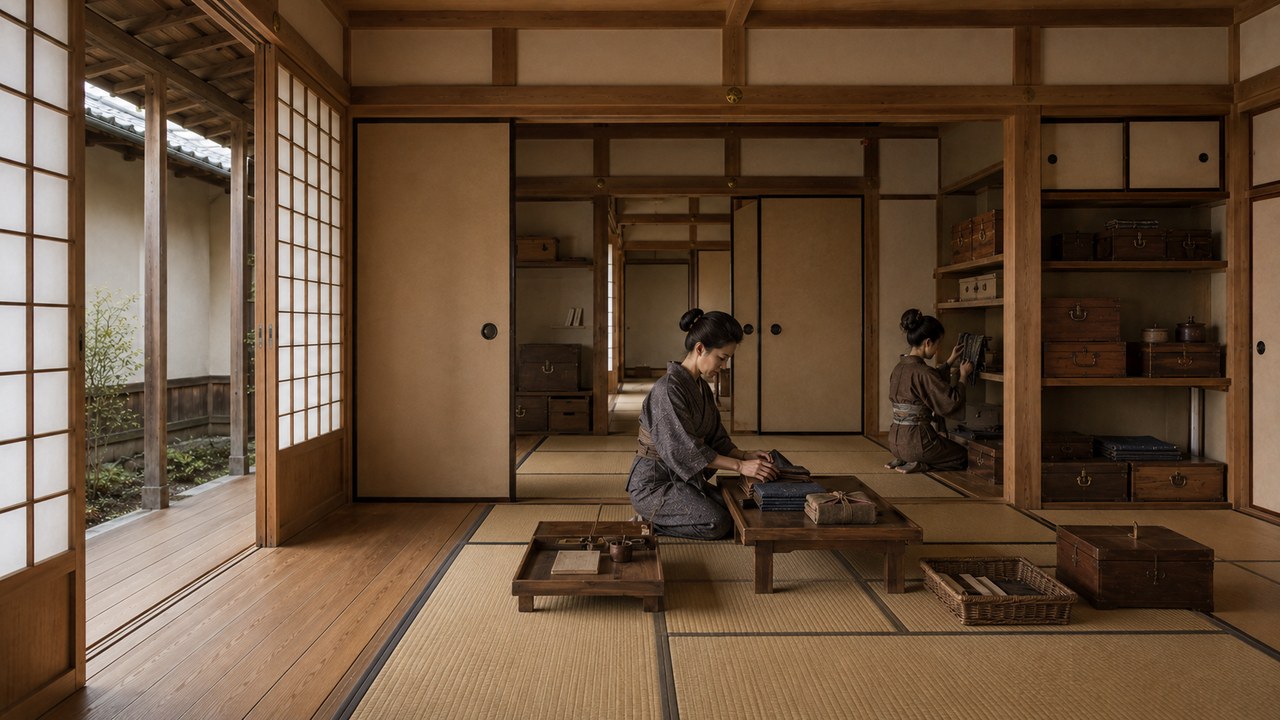
Historical labor becomes easier to understand when it is shown as a route. A textile bundle enters one room. An instruction moves to another. A corridor connects living quarters with a work area. A person prepares an object before someone of higher rank needs it.
These are small actions, but together they reveal the institution more clearly than a static portrait of a “court woman.”
The Nagatsubone as lived infrastructure
Later plans and explanatory materials identify the Nagatsubone area as quarters associated with female attendants. OCS uses that evidence carefully: it helps establish the idea of women living inside a structured service environment, while exact room arrangements for 1640 remain subject to the early-Edo evidence gate.
From “women in history” to women inside a working world
OCS reconstructs the human viewpoint first, then expands outward into rooms, objects, facilities, physical constraints and background life. A female attendant is not merely a character costume. Her job is a route through the world.
Daily Life Inside the Ooku → · Otsune — a fictional 1640 doorway →
Sources and limits
- Tokyo Metropolitan Library — Women Working in Edo Castle / Ooku materials
- Edo-Tokyo Museum — Ooku exhibition
Exact titles, duties and room arrangements must be tied to the period of the source. Later-Edo systems are not automatically treated as facts for 1640.