OOKU / DAILY LIFE / WORK / MATERIAL CULTURE
Daily Life Inside the Ooku
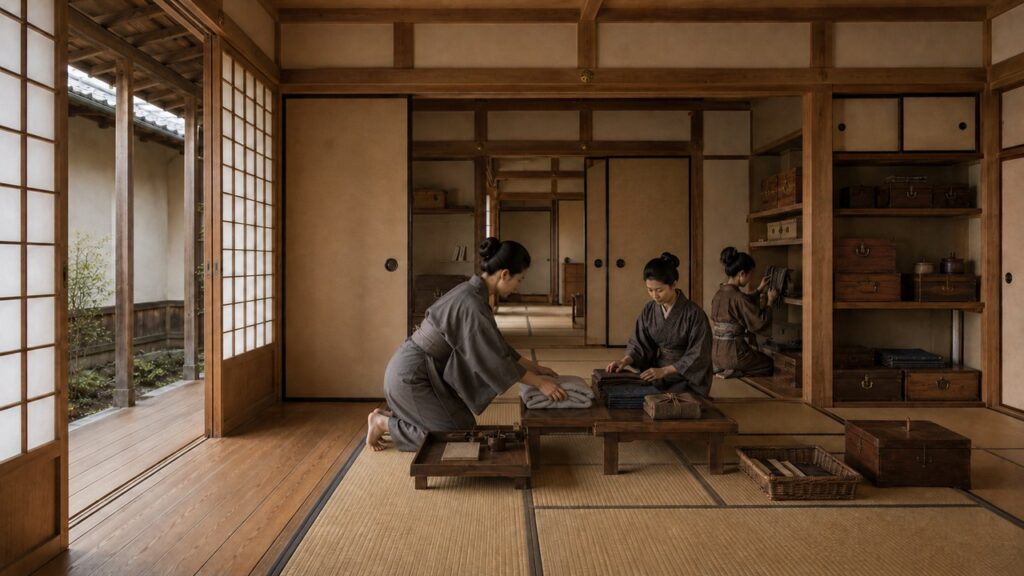
The Ooku is easy to imagine as ceremony, rank and political drama. Everyday life was also made from repeated work: preparing rooms, carrying objects, managing clothing, waiting, delivering instructions, eating, resting and moving through controlled spaces.
A day is made from transitions
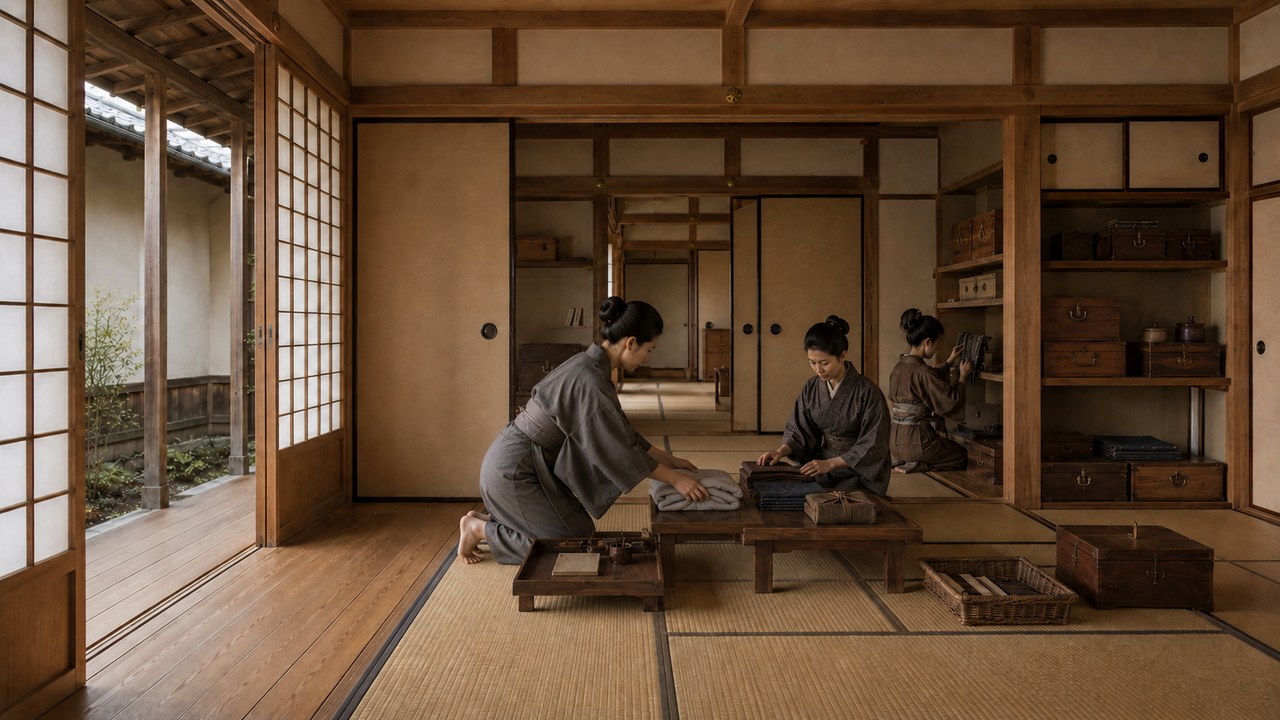
Historical institutions become tangible through transitions. A woman leaves her living quarters. A bundle is carried into a work room. A corridor is crossed. An object is checked before use. Someone waits because access to another zone is restricted.
These actions may look minor, but they reveal how SPACE and WORK fit together.
Rooms were not interchangeable
The surviving architectural evidence distinguishes residential, formal, administrative and service functions. That means an object entering the wrong room is not merely a visual mistake; it changes the workflow. OCS therefore treats routes, thresholds and room function as historical constraints.
Objects make the institution visible
Textiles, storage, paper, trays, lighting, containers and work surfaces connect the body to the palace. OCS does not use such objects as decorative “Edo props.” Each object should have a plausible owner, route, use, storage location and material behavior.
Work continued without a dramatic event
Most historical life did not occur at the moment of a famous incident. Household systems continued in ordinary time. That continuity is useful for understanding the Ooku because it allows the viewer to see the institution functioning rather than waiting for a political climax.
OCS: WORLD made felt
Movement, routes, objects in use, background life, work flow, sound and material behavior make the historical world visible before any explanatory text is read.
Sources and caution
- Tokyo Metropolitan Library — Ooku and women working in Edo Castle
- Edo-Tokyo Museum — Ooku exhibition
Later-Edo records can illuminate types of work and space, but exact routines are not projected backward into 1640 without period support.